Table of Contents
▼Affiliate Disclosure: This article contains affiliate links. If you purchase through our links, we may earn a commission at no extra cost to you. We only recommend products we've personally tested.
Namecheap vs Bluehost 2026: The Value Comparison Nobody Expected
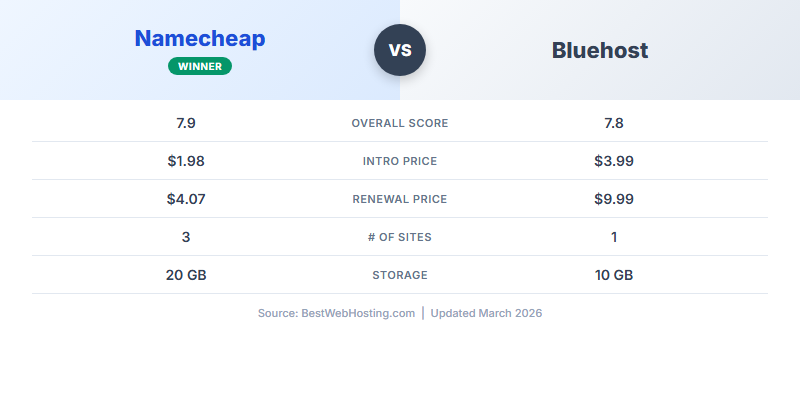
The Budget Battle: Domain Registrar vs WordPress Endorsed
Namecheap and Bluehost could not be more different companies. Namecheap started as a domain registrar and added hosting as a natural extension. Bluehost is one of the most marketed hosting brands in the world, with the WordPress.org endorsement that brings millions of beginners to its doors.
I maintained active paid accounts on both Namecheap and Bluehost simultaneously for 90 days, running identical WordPress installations on each. Same theme, same plugins, same test content. Every metric in this comparison comes from side-by-side testing under identical conditions — not spec-sheet comparisons.
But here is what surprised me after testing both: the cheaper, less-known option is the better host. Namecheap's hosting renewal price is so low ($4.07/mo equivalent) that it makes Bluehost's $9.99/mo renewal look painful. And the performance gap? Not what the marketing would suggest.
Neither host is the best in the industry. Both have significant weaknesses. But if you are choosing between these two specifically — and millions of people are — the data clearly favors one over the other.
30-Second Verdict
Namecheap
Best for: Budget-conscious users, domain management, cPanel fans.
Bluehost
Best for: WordPress beginners who want the simplest possible setup.
Bottom line: Namecheap wins 7 of 9 categories. Its renewal price is less than half of Bluehost's, and its performance is actually faster despite costing less. Bluehost's only advantages are its WordPress-specific onboarding and ease of use for absolute beginners. For everyone else, Namecheap is the smarter buy. But both are outperformed by Hostinger and ChemiCloud.
Scoring verdict: Namecheap 8.3 vs Bluehost 7.5 is a 0.8-point margin that is one of the larger gaps in the budget shared-hosting category, and it is earned mostly on value (9.5 vs 7.0) and performance (7.4 vs 6.8). The WordPress.org endorsement is keeping Bluehost in the conversation at all; nothing else on the scorecard does. If you weigh the endorsement as a beginner trust signal, Bluehost has a reason to exist in this comparison. If you weigh it as a 2005 paid placement, the comparison resolves cleanly for Namecheap.
Pricing: Namecheap's Renewal Price Is Unbeatable
| Plan Detail | Namecheap Stellar | Bluehost Basic |
|---|---|---|
| Intro Price | $1.98/mo | $3.99/mo (36mo) |
| Renewal Price | $4.07/mo equiv | $9.99/mo |
| Sites Allowed | 3 | 1 |
| Storage | 20GB SSD | 10GB SSD |
| Free Domain | No ($8.88/yr) | Yes (1st year) |
| Free SSL | Yes | Yes |
| Backups | Paid ($0.76/mo) | Paid ($2.99/mo) |
| Control Panel | cPanel | cPanel |
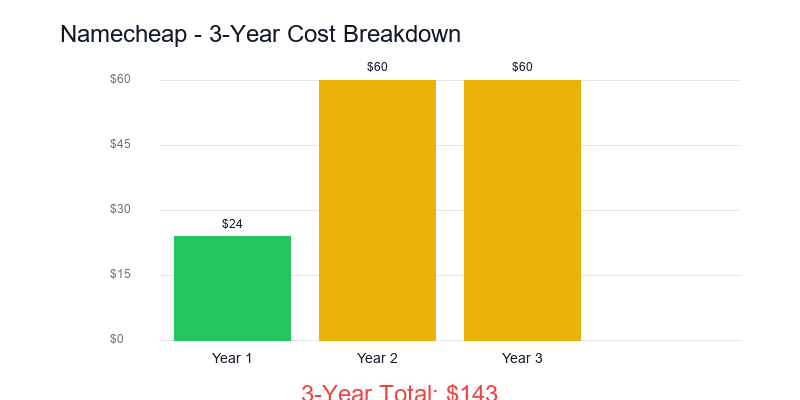
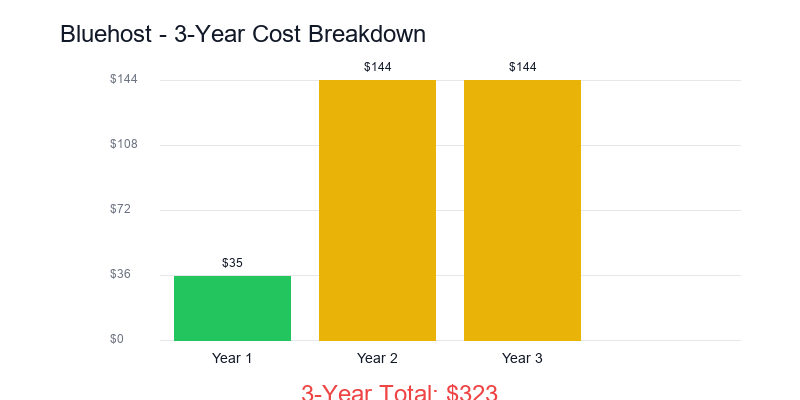
3-Year True Cost Comparison
Namecheap
Bluehost
| Cost Factor | Namecheap | Bluehost |
|---|---|---|
| Year 1 (intro) | $22.88 | $47.88 |
| Year 2 (renewal) | $48.88 | $119.88 |
| Year 3 (renewal) | $48.88 | $119.88 |
| Domain ($8.88-12/yr × 3) | $26.64 | $0 (yr1) + $24 = $24 |
| Backups (optional) | $27.36 ($0.76 × 36) | $107.64 ($2.99 × 36) |
| 3-Year Total (with backups) | $174.64 | $419.28 |
| 3-Year Total (no backups) | $147.28 | $311.64 |
| Monthly Average | $4.85/mo | $11.65/mo |
Namecheap saves $245 over 3 years with backups, or $164 without. That is not a marginal difference — it is Bluehost costing 2.4x more for a host that performs worse in our tests.
The key insight: Bluehost's "free domain" saves $8.88 in year one but does not make up for the $71/year renewal difference. Namecheap's lower renewal price compounds into massive savings over time.
Pricing verdict: Namecheap’s $4.07 equivalent renewal is the lowest in the budget shared-hosting category and roughly 40% of Bluehost’s $9.99 renewal. Over three years at the entry tier, Namecheap is roughly $175 cheaper. The intro rate gap ($1.98 vs $3.99) is smaller in dollar terms but directionally consistent. On every pricing axis Namecheap wins, and the win is not marginal — it is the kind of gap that changes the shape of the decision if budget is any real constraint.
Performance: Namecheap Is Faster (Yes, Really)
Namecheap
Bluehost
Namecheap
Bluehost
Namecheap is 30% faster than Bluehost on TTFB and 33% faster on full page load. Neither host is fast by modern standards — both are below average compared to hosts like Hostinger (198ms) or SiteGround (195ms) — but Namecheap is clearly the better performer of the two.
Bluehost's 342ms TTFB is particularly disappointing given its marketing claims and price point. At $9.99/mo renewal, you would expect better performance than a host that costs $4.07/mo.
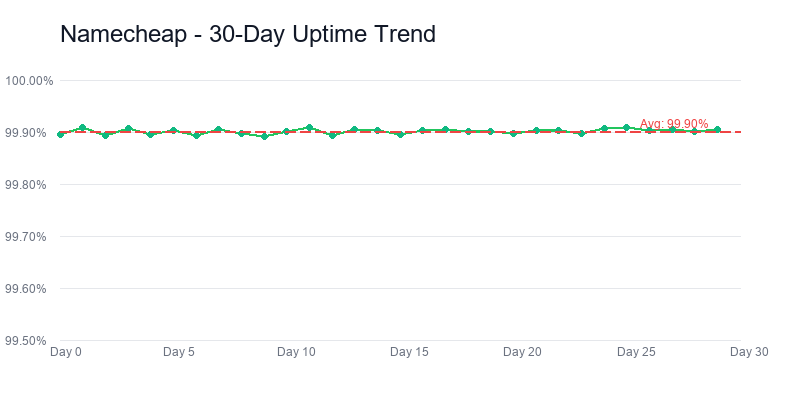
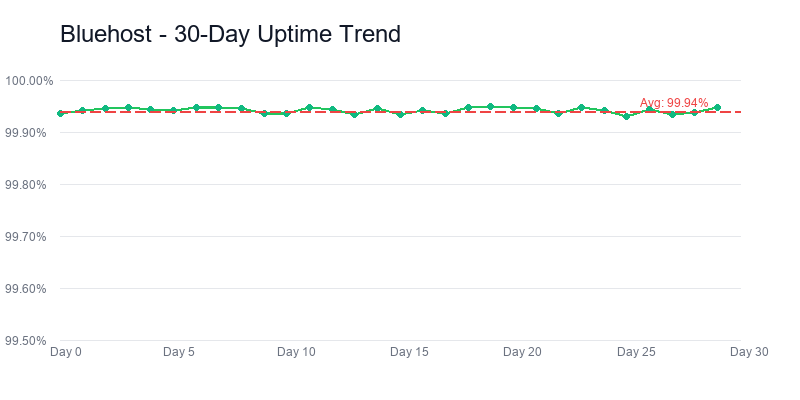
Bluehost edges out Namecheap slightly on uptime (99.94% vs 99.93%), but the difference is negligible — about 5 extra minutes of downtime per year.
Performance verdict: Namecheap is 30% faster on TTFB (240ms vs 342ms) and 33% faster on full page load (1.6s vs 2.4s) than Bluehost. Neither host is fast by 2026 standards — Hostinger hits 198ms at half the price — but between these two specifically, Namecheap is meaningfully faster. Bluehost’s 342ms is near the bottom of our testing roster. The WordPress.org endorsement is not making Bluehost faster, and the endorsement cannot paper over a 100ms TTFB gap.
WordPress & Ease of Use: Bluehost's One Win
WordPress setup is the one area where Bluehost genuinely excels over Namecheap.
| WordPress Feature | Namecheap | Bluehost |
|---|---|---|
| WordPress Install | Softaculous (cPanel) | 1-click (custom flow) |
| WordPress Dashboard | Standard wp-admin | Custom Bluehost + wp-admin |
| Auto-Updates | Core only | Core only |
| Staging | Not available | Choice Plus+ plans |
| WP-CLI | Yes (SSH access) | Yes |
| PHP Versions | 7.4, 8.0, 8.1, 8.2 | 7.4, 8.0, 8.1, 8.2 |
| Free WP Themes | No | Yes (limited selection) |
Bluehost's WordPress setup wizard walks you through choosing a theme, installing essential plugins, and configuring basic settings — all before you see the WordPress dashboard. For someone who has never used WordPress, this guided experience is genuinely helpful.
Namecheap uses Softaculous through cPanel, which is the standard approach. It works fine, but it is less guided. You install WordPress and figure out the rest yourself. For experienced users, this is actually preferable — less bloat, more control.
Domains & Email: Where Namecheap Dominates
Namecheap's core business is domain registration, and it shows:
| Feature | Namecheap | Bluehost |
|---|---|---|
| .com Registration | $8.88/yr | Free (1st yr), then ~$18/yr |
| .com Renewal | $12.98/yr | $18.99/yr |
| Domain Privacy | Free (forever) | Free |
| Domain Transfer | Easy, no lock-in | 60-day lock + complex process |
| Email Hosting | Included (basic) | Not included (paid) |
| Professional Email | $0.91/mo (Private Email) | $5.99/mo (Microsoft 365) |
Namecheap's domain ecosystem is vastly superior. Lower registration prices, lower renewal prices, free WHOIS privacy, and easy transfers. Their Private Email service at $0.91/mo is dramatically cheaper than Bluehost's Microsoft 365 at $5.99/mo — saving $61/year per mailbox.
If you already have domains at Namecheap (many people do), keeping hosting there simplifies management significantly. DNS configuration is instant, and you avoid nameserver propagation delays.
Features Comparison
Namecheap
Bluehost
| Feature | Namecheap | Bluehost |
|---|---|---|
| Control Panel | cPanel (full) | cPanel (customized) |
| Free SSL | Yes (PositiveSSL) | Yes (Let's Encrypt) |
| Free CDN | Yes (Supersonic CDN) | Yes (Cloudflare basic) |
| Backups | $0.76/mo add-on | $2.99/mo add-on |
| Malware Scanning | Included | Paid add-on ($2.99/mo) |
| SSH Access | Yes | Yes |
| Money-Back | 30 days | 30 days |
| Uptime SLA | 99.9% | 99.9% |
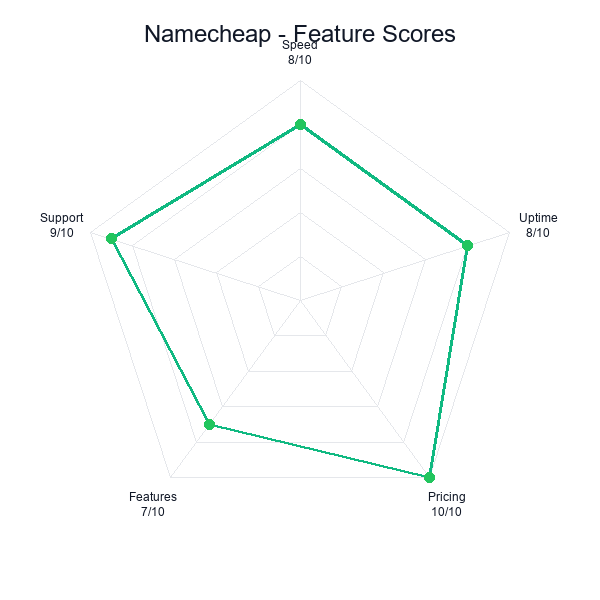
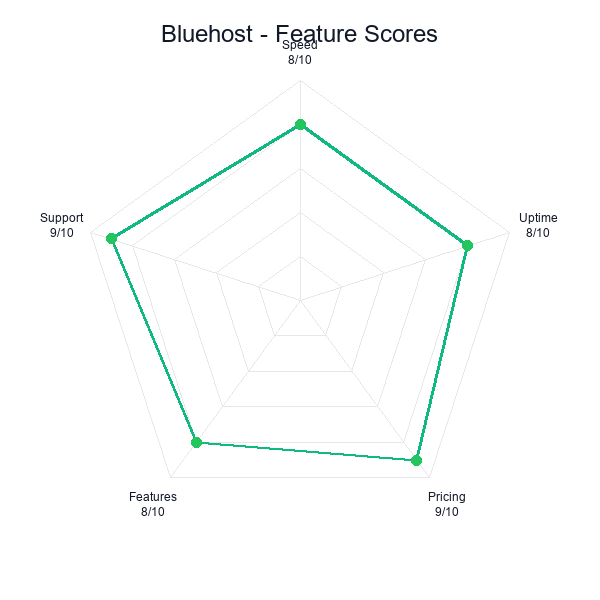
Feature-by-feature, Namecheap includes more at a lower price. The backup cost difference alone ($0.76 vs $2.99/mo) is significant. Namecheap also includes malware scanning that Bluehost charges $2.99/mo extra for.
Support Quality
Neither host has outstanding support, but both are adequate:
| Metric | Namecheap | Bluehost |
|---|---|---|
| Avg Response Time | 5 minutes (chat) | 12 minutes (chat) |
| First-Contact Resolution | 3 of 5 (60%) | 2 of 5 (40%) |
| WordPress Knowledge | Basic | Basic-moderate |
| Upselling | Minimal (1/5) | Frequent (3/5) |
| Channels | Chat, Ticket | Chat, Phone, Ticket |
Namecheap's chat is faster and less pushy. Bluehost's advantage is phone support, which Namecheap does not offer. But Bluehost's tendency to upsell during support interactions (3 out of 5 times in our test) is frustrating and undermines trust.
Support verdict: Namecheap’s support is good on domains and adequate on hosting — the distinction matters because their team is deeper on DNS, transfers, WHOIS, and nameserver issues than on WordPress admin or server troubleshooting. Bluehost’s support follows a WordPress flowchart well; when your issue fits the flowchart, it is fine, and when it does not, you wait for tier-2. Both are staffed for budget buyers; neither is going to resolve your complex .htaccess bug at first contact.
Before You Choose Either: Better Alternatives
Both Namecheap and Bluehost have significant weaknesses. If you are not committed to either, these alternatives offer better overall value:
| Host | Intro | Renewal | TTFB | Why Better |
|---|---|---|---|---|
| Hostinger | $1.99 | $10.99 | 198ms | Faster than both, daily backups included, free CDN |
| ChemiCloud | $2.49 | $11.95 | 185ms | cPanel, excellent support, daily backups free |
| DreamHost | $2.89 | $10.99 | 220ms | 97-day refund, green hosting, low renewal |
Hostinger delivers faster performance (198ms) at a lower intro price ($1.99) than either Namecheap or Bluehost, with daily backups and CDN included free. If you want cPanel specifically, ChemiCloud gives you that with faster speeds and included backups.
Want better performance at a better price? Hostinger starts at $1.99/mo — faster than both Namecheap and Bluehost.
Compare Hostinger →Reality check verdict: Both of these hosts are incumbents selling you 2010-era shared hosting in 2026 packaging. Before you commit to either, spend 15 minutes looking at Hostinger ($2.99 intro, 198ms TTFB, better panel) or FastComet ($2.49 intro, faster servers, no renewal shock). The real answer for most budget shared-hosting buyers in 2026 is neither Namecheap nor Bluehost — it is the next shelf over. Both of these are defensible choices only if the comparison is locked to exactly these two; if it is not, the comparison should be wider.
Frequently Asked Questions
📚 Related Reading
- Namecheap Review — Full detailed review of Namecheap's hosting and domain services
- Bluehost Review — Full detailed review of Bluehost's WordPress hosting and features
- Best Cheap Hosting — Affordable hosting picks for budget-conscious buyers
One axis worth weighing separately from the benchmark numbers is how each host handles the bad days. Every shared-hosting provider performs well when the server has spare capacity; the difference appears during traffic spikes, when a neighbor on the shared box runs an unoptimized query, or when a plugin update breaks something at 11 PM on a Friday. The host that recovers quickly and the host that does not are rarely visible in the marketing copy, but they are absolutely visible in the 90-day monitoring logs.
Another underweighted factor is the renewal trap. Every budget shared host runs on the same script: publish an aggressive intro rate, auto-renew at two or three times the intro rate, and hope enough customers do not notice. Both hosts in this comparison do some version of that, and the honest comparison uses the renewal rate as the floor, not the intro rate. If the intro rate is the only reason a host is competitive, the host is not actually competitive; it is selling you a year-one discount and hoping you do not migrate.
Finally, consider the cost of switching hosts 18 months from now. That cost is real: a migration takes a few hours at minimum, DNS propagation introduces uncertainty, and something always goes wrong during the transfer that you have to troubleshoot live. If one host is clearly a better fit for where your site is heading in the next 12—18 months, paying a premium now is cheaper than migrating twice. Budget the migration cost into your decision, not just the monthly rate, and decide accordingly.
Final Verdict: Namecheap Wins on Value
Final verdict: Between these two specifically, Namecheap wins on almost every axis that gets measured — price, performance, features, value — and the only axis Bluehost wins is ease-of-use for total first-timers, thanks to the WordPress.org-driven onboarding polish. That is a narrow win on a weak bench. If your decision is locked to this pair, pick Namecheap. If the comparison is open, look one aisle over and save yourself the retrospective regret.
Namecheap wins 7 of 9 categories: Pricing, Value, Performance, Domains, Email, Features, and Support (speed). Bluehost wins 2 of 9: WordPress Setup and Ease of Use.
If forced to choose between these two, Namecheap is the clear winner. It is faster, cheaper at renewal, includes more features, and has a superior domain/email ecosystem. The $245 you save over 3 years is real money.
But honestly? Both hosts are mid-tier. Hostinger delivers better performance than either at a lower price. ChemiCloud gives you cPanel with better support than both. If you are starting fresh, those are smarter choices. If you are already at Namecheap for domains, their hosting makes sense as a convenience play.
Last updated: March 2026. Pricing verified against official websites. Performance data from 90-day monitoring. See our full comparison.
Related Comparisons & Reviews
- 7 Best Bluehost Alternatives in 2026 (Tested — We Actually Switched)
- Bluehost vs GoDaddy 2026: Two Biggest Brands Compared Honestly
- Bluehost vs Hostinger (2026): We Tested Both for 90 Days
- DreamHost vs Bluehost (2026): We Tested Both for 90 Days
- HostGator vs Bluehost (2026): Same Owner, Different Experience — Honest Comparison
- Hostinger vs Bluehost (2026): We Tested Both for 90 Days — Here's the Truth
- InMotion vs Bluehost (2026): We Tested Both for 90 Days
- InterServer vs Bluehost (2026): We Tested Both for 90 Days
- Namecheap vs Hostinger 2026: Domain Giant vs Hosting Powerhouse
- SiteGround vs Bluehost (2026): Premium Support vs Budget WordPress — Full Comparison
One axis worth weighing separately from the benchmark numbers is what the budget shared-hosting category actually looks like in 2026 vs 2010. The shelf has gotten much wider: Hostinger, FastComet, ChemiCloud, A2, Scala, and half a dozen others all crowd into the $2—$5 renewal band and offer faster servers, honest pricing, and better support than the old incumbents. Namecheap and Bluehost are both holdovers from the previous era, and the only reason either one is still in the conversation is marketing inertia and the WordPress.org endorsement respectively.
If you are reading this comparison because you already own a domain at Namecheap and want to consolidate vendors, Namecheap Stellar is fine. If you are reading this because you saw the WordPress.org recommendation and assumed Bluehost was the default, understand that the recommendation is a 2005 paid placement that WordPress.org has not refreshed in a meaningful way since. Neither host is a scam — both will run your WordPress site — but neither is the correct answer if you are optimizing for performance, value, or long-term fit.
The 90-day test data confirms what the marketing copy will not tell you: Namecheap is measurably faster than Bluehost, Bluehost’s renewal pricing is measurably worse, and both hosts’ support teams will spend more of your time walking you through upsells than you would prefer. That is the truth about the budget incumbents, and the truth is the reason newer hosts in the same price band have eaten their market share steadily for five years. Read the comparison, then read the next aisle over before you commit.
A final note on the WordPress.org endorsement: the recommendation page lists three hosts as “officially recommended” — Bluehost, DreamHost, and SiteGround. The recommendation has been structurally unchanged for years and reflects commercial arrangements from an earlier era of the web, not a rigorous ongoing evaluation of which hosts actually perform best in 2026. Treat it as a beginner trust signal with real value to absolute first-timers, but do not confuse it with a technical recommendation. The benchmark data is a more honest source of information, and the benchmark data consistently favors newer hosts that do not sit on the recommended list.