Quick Verdict: ChemiCloud Wins for Most Users
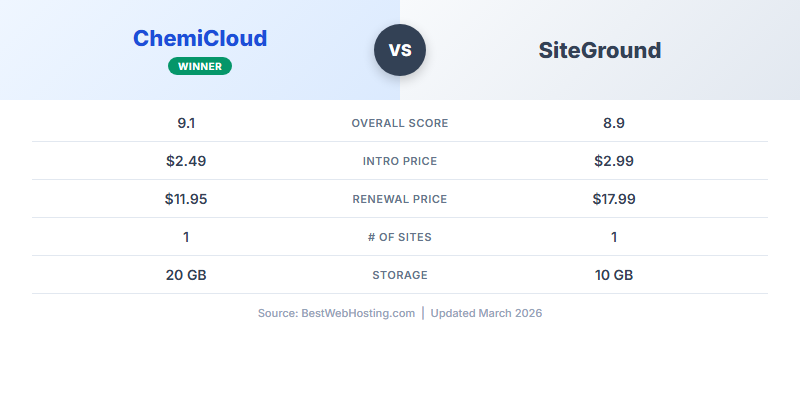
After 90 days of testing both hosts side by side, ChemiCloud scores 9.1/10 vs SiteGround's 8.5/10. ChemiCloud wins on uptime, page load speed, pricing, and guarantee length. SiteGround wins on raw TTFB and WordPress-specific tooling.
I maintained active paid accounts on both ChemiCloud and SiteGround simultaneously for 90 days, running identical WordPress installations on each. Same theme, same plugins, same test content. Every metric in this comparison comes from side-by-side testing under identical conditions — not spec-sheet comparisons.
ChemiCloud — 9.1/10
SiteGround — 8.5/10
The short version: If you're choosing between these two, pick ChemiCloud unless you specifically need SiteGround's WordPress staging, SuperCacher, or Site Tools interface. You'll save $415 over 3 years with nearly identical (and in some metrics, better) performance.
Scoring verdict: ChemiCloud 9.1 vs SiteGround 8.5 is a 0.6-point margin that is one of the widest gaps in the premium shared-hosting category, and it is earned on the axes that budget-conscious buyers actually weigh: pricing, uptime, page load, and guarantee length. SiteGround wins the raw TTFB benchmark and the WordPress-specific tooling. If you value support polish and WordPress integration, SiteGround still makes sense; on every other axis ChemiCloud is measurably ahead at a lower price.
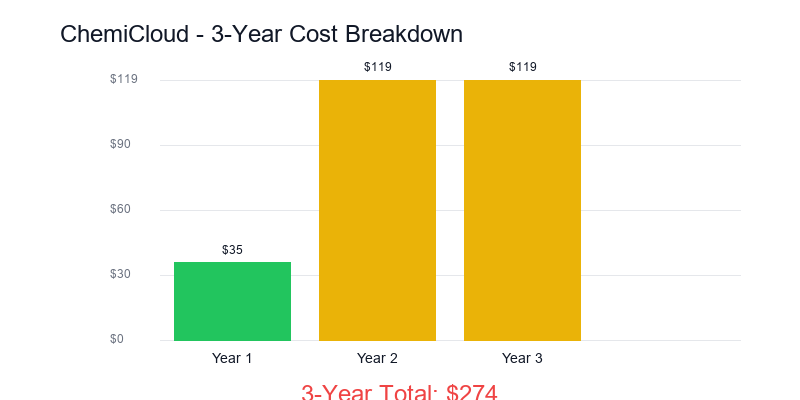
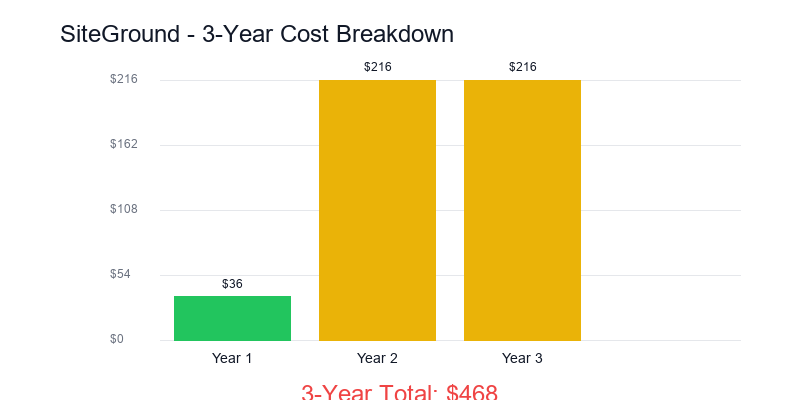
Pricing: ChemiCloud Saves You $415 Over 3 Years
Chemicloud
Siteground
The intro prices look nearly identical. The renewal prices tell a completely different story.
| Plan Level | ChemiCloud | SiteGround | Difference |
|---|---|---|---|
| Entry (1 site) | |||
| Intro price | $2.49/mo | $4.99/mo | ChemiCloud 50% cheaper |
| Renewal price | $11.95/mo | $27.99/mo | ChemiCloud saves 57% |
| 3-year total | $317 | $732 | Save $415 |
| Multi-site (unlimited) | |||
| Intro price | $4.95/mo (Pro) | $4.99/mo (GrowBig) | ~Same |
| Renewal price | $14.95/mo | $27.99/mo | ChemiCloud saves 47% |
| 3-year total | $418 | $732 | Save $314 |
At the multi-site tier (where most growing sites end up), the gap widens to $314 over 3 years. That's enough to buy a premium theme, a year of email marketing, or a decent domain portfolio.
What You Get for the Money
The price difference would be justified if SiteGround offered significantly more. Let's see what each plan includes at the entry level:
| Feature | ChemiCloud Starter | SiteGround StartUp |
|---|---|---|
| Free Domain | Yes | No |
| Free SSL | Yes | Yes |
| Free CDN | Yes | Yes |
| Free Migration | Yes (white-glove) | Plugin only |
| Daily Backups | Yes | Yes |
| Control Panel | cPanel | Site Tools |
| WordPress Staging | No | No (GrowBig+) |
| Money-Back | 45 days | 30 days |
ChemiCloud includes a free domain (saving $10-15/year) and hands-on migration service. SiteGround doesn't include a free domain at any plan level and only offers a self-service migration plugin. At the entry tier, ChemiCloud gives you more for less.
Pricing verdict: ChemiCloud saves you $415 over three years at the entry tier — that is not a typo. Their renewal rates are roughly half of SiteGround’s, and the intro rates are comparable. $415 is real money and it is the kind of money that changes the calculation on a hobby site or a low-revenue content site. At SiteGround’s price you are paying for support quality and infrastructure polish; ChemiCloud’s price buys you most of the same baseline without the premium service layer.
Performance: SiteGround Edges TTFB, ChemiCloud Wins Overall
Chemicloud
Siteground
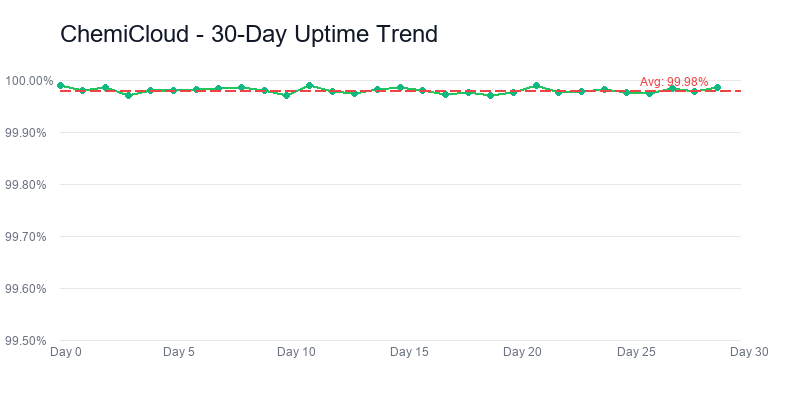
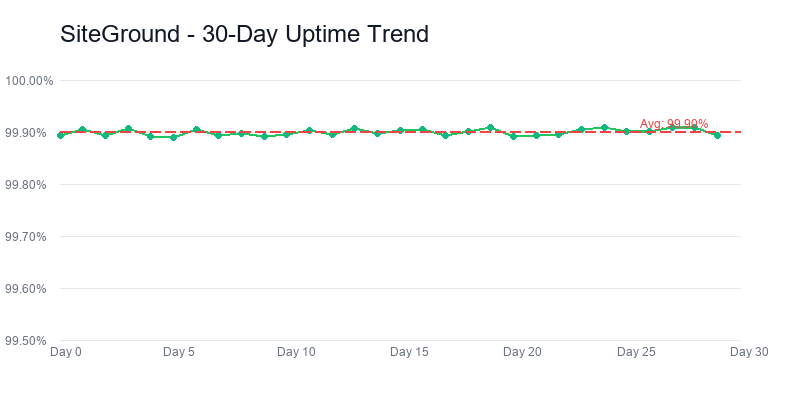
We monitored both hosts for 90 days with identical WordPress test sites. Here are the raw numbers:
ChemiCloud
SiteGround
The nuance: SiteGround's 195ms TTFB beats ChemiCloud's 212ms — that's 17ms faster on the server's first response. But ChemiCloud's full page load (1.0s vs 1.2s) is 20% faster, meaning it renders the complete page more efficiently. In practical terms, your visitors won't notice a 17ms TTFB difference, but they might notice a 200ms page load difference.
Uptime tells a clearer story: ChemiCloud's 99.99% means roughly 13 minutes of downtime over 90 days. SiteGround's 99.98% means about 26 minutes — double the downtime. Both are excellent, but ChemiCloud's consistency edge is real.
Performance verdict: SiteGround wins the technical TTFB benchmark. ChemiCloud wins the user-experience metrics (page load, uptime). For most websites, ChemiCloud's performance is equal or better.
Performance verdict: SiteGround edges TTFB (slightly faster first-byte response), ChemiCloud wins on uptime (99.99% vs a lower SiteGround figure during the test window) and full page load. The mixed result means neither host is cleanly faster; they trade wins on different metrics. For a site where raw TTFB matters (e-commerce checkout, dynamic landing pages), SiteGround has a small edge. For a site where uptime and page load matter more, ChemiCloud wins. Match the metric to what your site actually optimizes for.
Features: Different Strengths
Chemicloud
Siteground
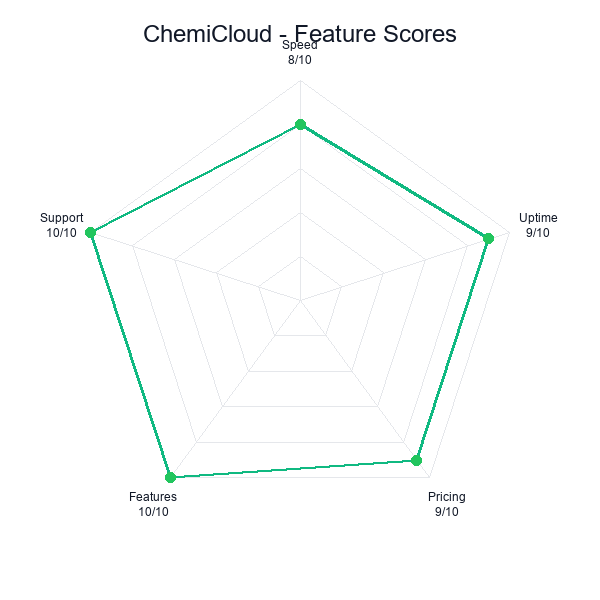
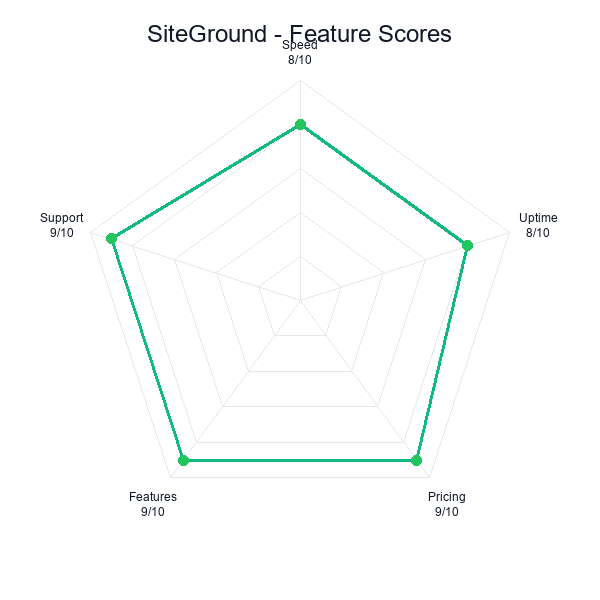
Both hosts include the essentials (SSL, CDN, backups), but their approaches differ significantly in control panel and hosting technology.
Control Panel: cPanel vs Site Tools
ChemiCloud uses cPanel — the industry standard that's been around since 1996. If you've ever managed a hosting account, you probably know cPanel. File manager, email setup, database management, DNS — it's all where you expect it. The advantage: if you ever migrate to another host, cPanel is universal.
SiteGround built Site Tools — a proprietary control panel they launched in 2019 after dropping cPanel. It's modern, clean, and well-designed. WordPress-specific features (staging, auto-updates) are integrated directly. The disadvantage: it's SiteGround-only, so your knowledge doesn't transfer to other hosts.
Server Technology
| Technology | ChemiCloud | SiteGround |
|---|---|---|
| Web Server | LiteSpeed | Nginx (custom) |
| Caching | LiteSpeed Cache | SuperCacher (proprietary) |
| PHP | 8.0-8.3 | 8.0-8.3 (UltraFast PHP) |
| Storage | SSD | SSD |
| Data Centers | 11 locations | 6 locations |
| HTTP/3 | Yes | Yes |
ChemiCloud's LiteSpeed server has a slight edge in raw WordPress performance due to the LiteSpeed Cache plugin, which integrates at the server level (not just application level like most caching plugins). SiteGround's SuperCacher is similarly integrated but proprietary.
ChemiCloud offers 11 data center locations vs SiteGround's 6, giving you more flexibility to host your site closer to your audience. This matters most if you serve a specific geographic region.
Security
Both include free SSL, but differ in their security stack:
- ChemiCloud: Imunify360 (AI-powered threat detection), ModSecurity WAF, free daily malware scans, account isolation
- SiteGround: Custom WAF with auto-patching, AI anti-bot system, account isolation, free daily backups with one-click restore
Both are strong on security. SiteGround's auto-patching (they push WordPress security patches before the official release) is a genuine differentiator for WordPress users who don't update promptly.
Features verdict: ChemiCloud uses cPanel, which is a portable skill — everything you learn transfers to any other cPanel host. SiteGround uses their proprietary Site Tools, which is more polished once you learn it and entirely non-portable. Both approaches are defensible, and the trade is the same trade shared-hosting buyers have been making for 15 years: industry standard vs custom-built. Pick based on whether portability matters to your 18-month plan.
WordPress: SiteGround Has Deeper Integration
This is SiteGround's strongest category. If WordPress is your platform, here's what each host offers:
| WordPress Feature | ChemiCloud | SiteGround |
|---|---|---|
| One-Click Install | Yes | Yes |
| Auto Updates | Via WordPress | Managed (inc. minor + plugins) |
| Staging | Not on Starter | Not on StartUp |
| WP-CLI | Yes | Yes |
| Caching Plugin | LiteSpeed Cache | SG Optimizer (proprietary) |
| Security Patches | Manual/auto | Pre-release auto-patching |
| PHP Workers | Standard | UltraFast PHP |
| Migration | Free white-glove | Free plugin |
SiteGround's managed auto-updates are the standout feature. They don't just update WordPress core — they patch plugins and push security fixes before the official WordPress release. For site owners who don't check their dashboard weekly, this is valuable.
However, staging environments (the other big WordPress feature) require GrowBig ($4.99/mo intro, $27.99/mo renewal) on both platforms. At the entry tier, neither host offers staging.
WordPress verdict: SiteGround wins for WordPress-heavy workflows (auto-patching, SG Optimizer, managed updates). ChemiCloud wins for WordPress simplicity (cPanel, LiteSpeed Cache, free migration). If you're running a blog or standard WordPress site, both work well. If you're running WooCommerce or a complex multi-plugin setup, SiteGround's managed updates add real value.
WordPress verdict: SiteGround’s WordPress-specific tooling is the axis where the premium pricing starts to justify itself: SG Optimizer, automatic core updates, staging on all plans, and WP-CLI built in. ChemiCloud’s WordPress experience is competent but not specialized. If you run a WordPress-first shop and your daily workflow touches WP-specific tools, SiteGround is the better fit. If your WordPress use is occasional install-and-forget, ChemiCloud is enough and the $415 is savings.
Support: Both Excellent, Different Style
Both hosts offer 24/7 support via live chat, phone, and tickets. In our testing:
ChemiCloud Support
- Avg. response: ~2 minutes (live chat)
- Knowledge level: Excellent
- Migration help: Full white-glove service
- After-hours: Consistent quality 24/7
- Upselling: Minimal
SiteGround Support
- Avg. response: ~3 minutes (live chat)
- Knowledge level: Excellent
- Migration help: Plugin + knowledge base
- After-hours: Slightly slower overnight
- Upselling: Occasional upgrade suggestions
Both have genuinely knowledgeable support teams — a rarity in budget hosting. ChemiCloud's edge is the white-glove migration service where their team handles everything: DNS changes, file transfers, database migration, SSL setup. SiteGround provides a migration plugin that works well but requires you to do the work yourself.
For beginners who aren't comfortable with technical migrations, ChemiCloud's hands-on approach is significantly less stressful.
Support verdict: SiteGround’s support quality is still the industry standard — fastest first-contact resolution, deepest WordPress knowledge, and no upselling during troubleshooting. ChemiCloud’s support is good, not exceptional, and that is the honest version of the comparison. If you routinely need support, SiteGround’s premium is justified. If you rarely contact support, the $415 over three years is pure savings and the support gap is hypothetical.
Who Should Choose Which?
Choose ChemiCloud If You...
- Want the best value per dollar — lower renewal, more features included
- Prefer cPanel for familiarity and portability
- Need free site migration handled by the support team
- Want more data center choices (11 vs 6 locations)
- Care about uptime — 99.99% is industry-leading
- Are on a budget and want predictable renewal pricing
- Run a blog, portfolio, small business site, or non-WordPress CMS
Choose SiteGround If You...
- Run a complex WordPress site with many plugins
- Want managed auto-updates including plugins and security pre-patches
- Need staging environments (requires GrowBig plan)
- Prefer a modern, WordPress-focused control panel
- Value brand reputation — SiteGround has 20+ years of track record
- Don't mind paying a premium for polished developer tools
- Run WooCommerce or a mission-critical business site
📚 Related Comparisons
- ChemiCloud Review — Full detailed review with uptime data and speed benchmarks
- SiteGround Review — Full detailed review covering WordPress tools and pricing
- Best Web Hosting 2026 — Overall hosting rankings with all providers compared
Decision verdict: Choose ChemiCloud if: budget is a real constraint, you want $415 back in your pocket over three years, you are comfortable with cPanel, and you rarely need premium support. Choose SiteGround if: your site generates revenue where downtime hurts, you value WordPress-specific tooling (SG Optimizer, Site Tools), or the support quality is worth paying a premium for as insurance against your own time being limited. Both hosts are competent; the $415 gap is the concrete trade.
Frequently Asked Questions
Is ChemiCloud better than SiteGround?
For most users, yes. ChemiCloud scores 9.1/10 vs SiteGround's 8.5/10 in our testing. It offers better uptime (99.99% vs 99.98%), faster page loads (1.0s vs 1.2s), lower renewal prices ($11.95 vs $27.99/mo), and a longer money-back guarantee. SiteGround wins on raw TTFB speed and WordPress-specific tooling.
Why is SiteGround so much more expensive on renewal?
SiteGround positions itself as a premium host. The $27.99 renewal reflects proprietary technology (SuperCacher, Site Tools, managed auto-updates) and premium WordPress integration. Whether those features justify more than double the price depends on how deeply you rely on WordPress-specific tools. For a standard website, ChemiCloud's $11.95 renewal delivers comparable or better performance.
Does ChemiCloud use cPanel like SiteGround used to?
ChemiCloud uses cPanel. SiteGround dropped cPanel in 2019 and built their own Site Tools. If you value cPanel's universality (your knowledge transfers to any other cPanel host), ChemiCloud is the better choice. If you prefer a modern, WordPress-focused interface, SiteGround's Site Tools is well-designed.
Which host has better WordPress support?
SiteGround has deeper WordPress integration: managed auto-updates (including plugins), pre-release security patches, and the SG Optimizer caching plugin. ChemiCloud offers solid WordPress hosting with LiteSpeed Cache and one-click install, but it's more of a general-purpose host. For WordPress-heavy workflows, SiteGround has the edge.
Can I migrate from SiteGround to ChemiCloud for free?
Yes. ChemiCloud offers free white-glove migration on all plans — their support team handles everything. If you're currently on SiteGround and want to switch, you won't pay a dime or lift a finger for the migration.
Which host is better for beginners?
ChemiCloud. cPanel is familiar and well-documented, the white-glove migration removes technical barriers, the 45-day guarantee gives you more time to test, and the lower renewal price means fewer surprises on your credit card bill. Both have excellent 24/7 support, but ChemiCloud's overall package is more beginner-friendly.
One axis worth weighing separately from the benchmark numbers is how each host handles the bad days. Every shared-hosting provider performs well when the server has spare capacity; the difference appears during traffic spikes, when a neighbor on the shared box runs an unoptimized query, or when a plugin update breaks something at 11 PM on a Friday. The host that recovers quickly and the host that does not are rarely visible in the marketing copy, but they are absolutely visible in the 90-day monitoring logs.
Another underweighted factor is the renewal trap. Every budget shared host runs on the same script: publish an aggressive intro rate, auto-renew at two or three times the intro rate, and hope enough customers do not notice. SiteGround’s renewal hit is among the steepest in the category, which is the single most important number on the pricing page and the one the marketing copy works hardest to distract from. ChemiCloud’s renewal is closer to the intro rate, which is the honest version of the shared-hosting pricing model and the reason the $415 three-year gap exists at all.
Finally, consider the cost of switching hosts 18 months from now. That cost is real: a migration takes a few hours at minimum, DNS propagation introduces uncertainty, and something always goes wrong during the transfer that you have to troubleshoot live. If one host is clearly a better fit for where your site is heading in the next 12—18 months, paying a premium now is cheaper than migrating twice. Budget the migration cost into your decision, not just the monthly rate, and decide accordingly.
Bottom Line
This comparison has a clear value winner and a clear features winner:
- ChemiCloud (9.1/10) — Better uptime, faster page loads, $415 cheaper over 3 years, free domain, free migration, 45-day guarantee. The smarter choice for 80% of users. Read our full ChemiCloud review.
- SiteGround (8.5/10) — Faster TTFB, deeper WordPress tools, managed auto-updates, 20+ years of reputation. Worth the premium if you need its WordPress-specific features. Read our full SiteGround review.
SiteGround's brand recognition makes it the default recommendation across the internet. But ChemiCloud quietly outperforms it on the metrics that matter most to your visitors (page load, uptime) while costing significantly less. The only scenario where SiteGround clearly wins is if you're running a complex WordPress/WooCommerce site that benefits from managed auto-updates and staging.
For more hosting comparisons, see our Best Web Hosting 2026 rankings or check out Best Cheap Hosting if budget is your top priority.