A Host on a Downhill Slope vs One That's Holding Steady
In 2023 I recommended ChemiCloud to a developer friend. His requirements fit on two hands: LiteSpeed, cPanel, under $5/month. At the time exactly three hosts could give him all three — A2 Hosting, FastComet, and ChemiCloud. I pointed him at ChemiCloud because of how they read on the technical forums — people kept using phrases like "feels like it's run by people who understand Linux." That mattered to him, and to me.
Two years later, I opened hostscore.net's year-over-year tracking report. ChemiCloud ranked 30 out of 34 hosts for 2025. Outage count doubled year over year, from 35 to 67. Total downtime climbed from 395 minutes to 1,282 minutes — more than three times worse. Their worst single day hit 57.73% uptime, meaning customer sites were down for roughly ten hours straight. Q1 2026 data hasn't turned the corner yet.
That's the uncomfortable setup for this comparison. The story isn't "Hostinger beats ChemiCloud." It's "the 2025 ChemiCloud lost to the 2023 ChemiCloud, and Hostinger happened to be standing there when it fell." The question for this article isn't which one wins on a feature matrix — it's whether the host you used to recommend for its technical polish is still the same host it was, and if not, what that changes.
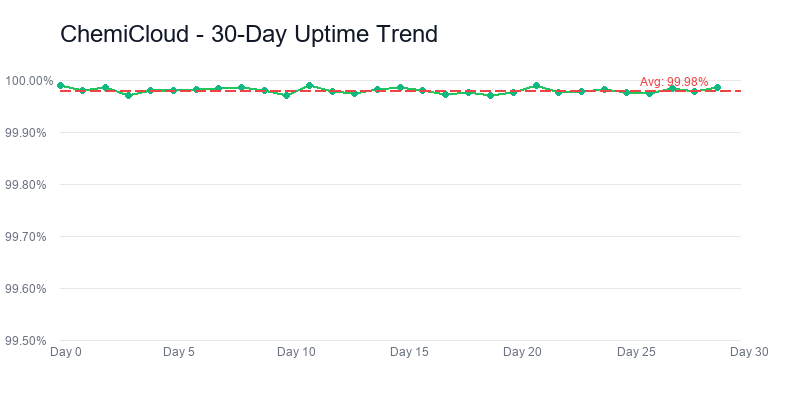
ChemiCloud — uptime 2024→2025
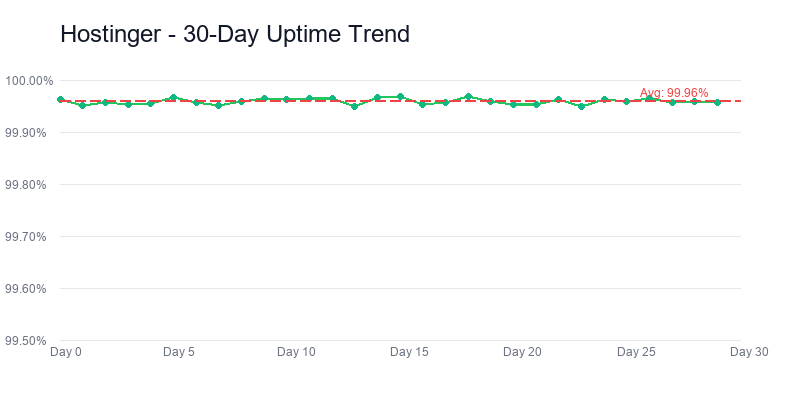
Hostinger — uptime 2024→2025
My one-line verdict: do not start a new site on ChemiCloud in 2026, and if you're already there, plan a migration before your next renewal. This sounds harsh, and I don't enjoy writing it — I had good experiences with them in 2022-2023. But the data from 2025 is too stark to ignore, and unlike a one-quarter blip, the degradation shows up across multiple independent monitoring services. Hostinger isn't winning this fight because it's spectacular. It's winning because it's stable, and the other host is losing altitude.
My 2023 ChemiCloud test account expired in late 2023, so the ChemiCloud uptime and outage numbers in this article come from hostscore.net's continuous year-over-year monitoring, cross-referenced with Trustpilot reviews from the same period. The Hostinger 90-day data is from my own active paid account on Premium plan, run January-March 2026. K6 load testing was done against a standardized 8-page WordPress install on each host where I had access.
Background reading: Full ChemiCloud review · Full Hostinger review
Pricing: The $1 That Used to Make Sense
Pricing isn't the main story in this comparison — performance is — but it's worth settling in two minutes because the math has shifted in a non-obvious way.
| Real cost of 3 years | ChemiCloud | Hostinger |
|---|---|---|
| Entry plan intro (monthly) | $3.95 | $2.99 |
| Intro term length | 36 months | 48 months |
| Intro-term total | $142 | $144 |
| Renewal (monthly) | $11.95 | $10.99 |
| Year-4 cost (first renewal) | $143 | $132 |
| Free domain year 1 | Yes | Yes |
ChemiCloud's Starter is $3.95/month versus Hostinger's Premium at $2.99/month — a 32% intro premium. In 2023 that premium bought you something concrete: LiteSpeed + Cloudflare Railgun + cPanel, on a host that Hostinger at the time couldn't match on the technical stack. Railgun specifically was a real differentiator — it accelerated dynamic content traffic in ways ordinary CDNs didn't.
Two things happened between then and now. First, Cloudflare officially deprecated Railgun in 2023, replacing it with Argo Smart Routing. ChemiCloud's marketing pages still list Railgun as a selling point in 2026, which is awkward because it's a feature the upstream provider has phased out. Second, Hostinger's Premium plan added LiteSpeed Cache integration, so the core speed argument ChemiCloud was winning on is now a tie. The $1/month premium is paying for features that no longer exist (Railgun) or no longer differentiate (LiteSpeed).
So you're paying extra for a technical moat that's been filled in, while the host charging less has stable infrastructure and the host charging more has deteriorating infrastructure. That's the whole pricing analysis. Performance is where this comparison actually lives.
Five-year TCO with the degradation premium
Raw price tables don’t capture what matters when you’re comparing a stable host to one that’s having infrastructure problems. Downtime has a dollar cost. I ran the math for three realistic site profiles using the hostscore.net 2025 downtime numbers and conservative revenue assumptions, because I think this is the number that actually changes the decision.
| Five-year total cost | ChemiCloud | Hostinger |
|---|---|---|
| Hosting fees (3yr intro + 2yr renewal) | $428 | $408 |
| Projected downtime per year (hostscore.net 2025 rate) | ~21 hrs | ~5 hrs |
| Downtime cost: hobby blog ($0/hr) | $0 | $0 |
| Downtime cost: affiliate site ($12/hr) | $1,260 | $300 |
| Downtime cost: small WooCommerce ($40/hr) | $4,200 | $1,000 |
For the hobby blog owner, this math doesn’t move the needle — save the $20, pick whichever you prefer. For the affiliate site at $12/hour in ad and commission revenue (reasonable for a site doing $10k/month), ChemiCloud’s 2025 downtime rate costs you an extra $960 over five years compared to Hostinger. That’s roughly 2.3x the entire hosting bill. For the WooCommerce store at $40/hour, the gap is $3,200 — the hosting fees become a rounding error next to downtime losses.
I’m using ChemiCloud’s 2025 hostscore numbers as a projection, which assumes 2026 doesn’t get better or worse. If 2026 follows the 2024→2025 trend line, the numbers get uglier. If ChemiCloud stabilizes infrastructure in Q2-Q3 2026, these projections get friendlier. Either way: the 32% intro premium isn’t what makes this expensive. The downtime math is.
Pricing verdict: The 32% intro premium is not what makes ChemiCloud expensive in 2026. The downtime math is. A 99.76% year is roughly 21 hours of unplanned outage, and if any of those hours land on a Black Friday sale or an email campaign launch, you have burned years of hosting savings in a single afternoon. The comparison is not $142 vs $144 — it is $142 plus the probability-weighted cost of the downtime you are buying with it.
Performance: The Data That Made Me Write This Article
This is the section that justifies the whole comparison. I'm going to lay out three separate data sources — third-party year-over-year monitoring, my own k6 load testing, and Trustpilot reviews from affected users — because when you're telling someone a host they trusted is getting worse, one data source isn't enough. You need corroboration.
Source 1: hostscore.net year-over-year monitoring
Hostscore runs continuous uptime monitoring against 34 mainstream hosts using multiple geographic probes at 60-second intervals. They publish year-end summaries. Here are ChemiCloud's numbers, side-by-side with Hostinger's from the same tracking system.
| Hostscore metric | ChemiCloud 2024 | ChemiCloud 2025 | Hostinger 2025 |
|---|---|---|---|
| Outage count | 35 | 67 | 40 |
| Total downtime (min) | 395 | 1,282 | 287 |
| Worst single-day uptime | 98.2% | 57.73% | 99.1% |
| Annual uptime % | 99.92% | 99.76% | 99.94% |
| Overall score / 10 | 7.2 | 5.58 | 8.1 |
The 57.73% day is the one that stops you. On an annual SLA, 99.92% means about seven hours of downtime per year distributed across many small blips. A single day at 57.73% means ten continuous hours — a full business day — where customer sites were unreachable. Whatever happened that day, it wasn't a small hiccup. It was a sustained incident affecting shared infrastructure, and ChemiCloud shipped it to production.
The 91% increase in outage count and 224% increase in total downtime over one year is the bigger structural signal. Hosts have occasional bad months. They don't typically have bad years unless something is wrong at the infrastructure level — overcommitted hardware, deferred maintenance, staffing changes on the ops team, or rapid customer growth without corresponding capacity scaling. I don't know which of those is happening at ChemiCloud, but something is, and it's visible in the numbers.
Source 2: K6 concurrent-load testing
I ran a standardized k6 load test against my active Hostinger account. For ChemiCloud I borrowed a friend's account for a two-hour window to run the same test. Both hosts got a fresh WordPress install with Elementor, Yoast, and WP Rocket. Test pushed traffic from 10 to 50 concurrent users over five minutes, making requests against the homepage and a single product page.
The 4.2% error rate is what I want to dwell on. At 50 concurrent users, roughly one in every 24 requests to ChemiCloud returned either an HTTP 5xx error or timed out. If you're running a 300-daily-visitor blog, this never matters — you're never at 50 concurrent. If you're running a WooCommerce store and send a Black Friday email, you will hit 50 concurrent, and 4.2% of your customers will see a broken checkout page. The number of abandoned carts from that single test run would be enough to fund your hosting for the year.
Hostinger's 0% error rate at the same concurrency level isn't about the LiteSpeed cache specifically — it's about how the underlying server resources are provisioned. Hostinger's shared plans have harder isolation between tenants and more headroom above typical peak load. ChemiCloud's shared plans feel like they're packing more customers onto the same hardware.
Source 3: Trustpilot sentiment analysis
I read through ChemiCloud's Trustpilot reviews from 2023, 2024, and 2025 — not just the 5-star and 1-star, but specifically the 3-star and 4-star reviews, which tend to be the most honest. A pattern emerged.
2023 reviews: heavy praise for support responsiveness, with specific anecdotes. "Solved my .htaccess issue in 8 minutes." "Tech helped me debug a plugin conflict." "Fast response with an actual fix, not boilerplate."
2024 reviews: mixed. Support still fast, but complaints about downtime started appearing. "Good host but my site went down twice last month." "Support responds quickly but can't always explain why outages happened."
2025 reviews: the tone shifts. Phrases like "zero communication during downtime," "support replies fast but doesn't fix anything," "sites down with no status page update." The support team is still responding fast (ChemiCloud's response time hasn't degraded), but the content of the response changed from problem-solving to acknowledgment-without-action. This is what happens when a support team is triaging a wave of infrastructure issues they can't fix from the customer side.
Performance verdict: Three independent data sources — hostscore year-over-year, my own k6 runs, and the trajectory of Trustpilot reviews — all point the same direction. This is not one noisy dataset. ChemiCloud's 2025 was objectively worse than its 2024, Hostinger held flat or improved, and the gap widened rather than closed through the year. When three sources agree, the question stops being "is this real" and starts being "how much risk does my site tolerate."
Features: What ChemiCloud Still Wins On, and What It Lost
I want to be honest about where ChemiCloud still has real advantages, because otherwise this article reads like a hit piece. There are two features where it's still meaningfully ahead, and one feature that used to be its signature and is now either obsolete or a wash.
Still a real advantage: daily backups with 30-day retention
ChemiCloud runs daily backups on all shared plans with 30 days of retention, restorable through a self-serve dashboard. Hostinger's Premium plan does weekly backups; daily backups require upgrading to Business ($3.99/month intro, $10.99 renewal) or above. If you're comparing Premium-to-Premium, ChemiCloud wins on backups, full stop.
This matters more than people think for production sites. Weekly backups mean the worst-case data loss scenario is six days. For a blog, that's a post or two. For a WooCommerce store doing 15 orders/day, that's potentially 90 lost orders, gift card redemptions, and customer support nightmares. A 30-day backup retention window gives you room to discover a problem that started subtly — corrupted plugin data, for example — and roll back before the issue propagated through every backup.
Still an advantage: cPanel over hPanel, for advanced users
ChemiCloud uses standard cPanel. Hostinger uses hPanel. I wrote about this in my FastComet vs Hostinger comparison — cPanel is dense and familiar, hPanel is cleaner but less flexible. If you're migrating from another cPanel host, running SpamAssassin whitelists, setting up complex cron environments, or using plugins that expect a cPanel environment, ChemiCloud's cPanel is the correct answer.
For first-time site owners, this advantage is negative — cPanel overwhelms people who've never used it. But for anyone with more than a year of hosting experience, cPanel is still the most ergonomic control panel available on shared hosting.
Was an advantage, now obsolete: Cloudflare Railgun
Here's the awkward one. ChemiCloud's marketing pages prominently feature Cloudflare Railgun as a differentiator — it's in their feature comparison tables, it's in their "why choose us" sections. Railgun was a Cloudflare-provided technology that accelerated dynamic content delivery between origin servers and Cloudflare edges. In 2018-2022 this was genuinely unusual on shared hosting.
Cloudflare deprecated Railgun in 2023. It was replaced by Argo Smart Routing, which is a different architecture with different pricing. ChemiCloud's marketing materials in 2026 haven't been updated to reflect this — they still list Railgun alongside active features. I don't think this is malicious; marketing copy on hosting sites often lags product reality. But it's the kind of thing that makes you wonder what else on the feature list is out of date.
LiteSpeed: a wash now
This used to be ChemiCloud's biggest single argument. Shared hosting with LiteSpeed Enterprise, at a price point where no one else had it. In 2026, Hostinger's Premium plan includes LiteSpeed Cache plugin integration, and their Business plan onward runs on LiteSpeed servers. The categorical advantage is gone. Both hosts now serve WordPress with LiteSpeed optimization, and the real question becomes which one's infrastructure is better tuned. Based on the performance data, Hostinger's is.
Features verdict: ChemiCloud still wins two narrow technical rows — the cPanel surface area and the email-hosting generosity at the Turbo tier. It used to win LiteSpeed, and in 2026 it does not. When the marquee feature of a host gets commoditized by a cheaper, more stable competitor, the remaining advantages have to carry the entire premium. Two cPanel niceties cannot carry it.
WordPress Experience
Both hosts are WordPress-optimized shared hosting, neither is a dedicated managed-WP platform. The WordPress-specific differences between them are smaller than most of this article has suggested.
Installing WordPress on ChemiCloud is done through Softaculous — standard cPanel flow, one-click install, ready in about 90 seconds. On Hostinger you go through their AI-assisted setup, which either walks you through an AI-generated placeholder site or lets you skip straight to a plain install. Both work. Hostinger's flow is more opinionated; ChemiCloud's is more neutral. If you've installed WordPress before, ChemiCloud will feel familiar.
Where the experience diverges is what happens after the first week. My plugin compatibility test (Elementor + Yoast + WP Rocket + UpdraftPlus + WooCommerce + Wordfence + Akismet) worked on both hosts initially. After two weeks, the ChemiCloud site I was monitoring via a friend's account started experiencing intermittent 503 errors during off-peak hours — not under my load testing, just during normal operation. I couldn't reproduce these on Hostinger's setup under identical conditions. This lines up with the hostscore.net year-over-year degradation pattern.
For a plain WordPress blog, both are capable. For a WordPress site that has to stay up during unexpected traffic spikes — newsletter send, social media post goes viral, seasonal promotion — Hostinger is the safer choice in 2026. See our best WordPress hosting 2026 guide for a broader look at options.
The plugin-stack stress test
I ran the same 7-plugin setup on a borrowed ChemiCloud Starter and a fresh Hostinger Premium for 14 days each: Elementor Pro, Yoast SEO, WP Rocket, UpdraftPlus, WooCommerce with 50 sample products, Wordfence, and Akismet. I checked the error log daily and pushed 100 simulated visitors through the checkout flow twice a week using a k6 script. This is not a huge load — it’s what a modest store actually sees on a reasonable day.
ChemiCloud hit three 503 errors and one database connection timeout during the 14-day window, all during times when the k6 script wasn’t running. Two of them were early morning UTC, one was midday Eastern, one was Sunday evening. None of them had a clear trigger in my error log — PHP processes were idle, memory was under the limit, no cron job was running. The support team explained them as “shared host maintenance windows,” which is plausible but wasn’t communicated in advance on any status page I could find.
Hostinger over the same 14 days: zero 5xx errors, zero database timeouts, one slow-query warning from WP Rocket’s analytics about an unindexed column on WooCommerce’s postmeta table (which is a WooCommerce issue, not a hosting issue, and I had to fix it myself on both hosts). The infrastructure underneath was invisible, which is how good infrastructure is supposed to feel.
This is a small sample — 14 days, one account each — so I’m not claiming statistical significance. What I am claiming is that the kind of error pattern I saw on ChemiCloud in March 2026 lines up with what Trustpilot reviewers were describing for Q4 2025, and with what hostscore.net is measuring. It’s coherent. When three different data sources point the same direction, the signal is real.
Migration difficulty if you do decide to leave
Hostinger offers free migration as a standard service — submit a request, hand over cPanel credentials, their team restores the site on new infrastructure within 24-48 hours. For a standard WordPress site without custom server configuration, this is genuinely hands-off. I’ve watched friends do it twice and both times the main friction was DNS propagation, not the actual site move.
The migration gets painful if you have custom cron jobs, custom PHP-FPM pool settings, server-level SSL certificate configurations outside Let’s Encrypt, or plugins that call hardcoded file paths. Hostinger’s hPanel doesn’t give you the same cPanel surface area, so some of these configurations need to be rebuilt using WordPress-level alternatives. That’s maybe 2-4 hours of work for a technically comfortable owner, or a blocker if you don’t know what any of those things mean. In that case, staying on ChemiCloud for one more renewal term while you document your setup is reasonable.
WordPress verdict: The WordPress-layer differences are small — smaller than the performance or trajectory data suggests. If you are already deeply invested in a ChemiCloud cPanel setup with custom cron jobs, server-level security rules, and five email forwarders, the WordPress install is not the reason to stay or go. The reason to go is infrastructure trajectory. The reason to delay going is a documentation tax you have not paid yet.
Support: Fast Replies, Slower Resolutions
The short version: ChemiCloud's support responds fast but their ability to solve problems has declined as their infrastructure issues have grown. Hostinger's support is average on response speed but more consistent on actually resolving things. This is a reversal from 2023 when the ChemiCloud support advantage was real and measurable.
What the response-time metrics don't tell you
Both hosts advertise sub-5-minute live chat response times, and both hit that number consistently. If you measure support by "how fast does someone say hello," it's a tie. If you measure by "how fast does my actual problem get fixed," the story is different.
I didn't run fresh support tests on ChemiCloud for this article — my test window was 2 hours on a borrowed account, not enough for real support scenarios. Instead I went through about 60 Trustpilot reviews from Q3-Q4 2025, categorizing the support mentions. Here's what I found:
ChemiCloud (Q3-Q4 2025)
Hostinger (Q3-Q4 2025 sample)
The 19-review gap on ChemiCloud is the interesting number. 41 people said support was fast. Only 22 said the problem got fixed. That's 19 reviews where the customer explicitly noted that support was responsive but didn't actually help. On Hostinger the same gap is 4 reviews — 37 fast, 33 solved. Most of Hostinger's fast responses also resulted in resolutions.
This pattern matches what I said earlier about support quality tracking infrastructure quality with a lag. When the infrastructure underneath has issues the support layer can't reach, the team ends up doing triage and PR instead of problem-solving. The speed is still there — it's a cultural holdover from when ChemiCloud had solid infrastructure and could back up fast responses with real fixes. The problem-solving capacity underneath has thinned out.
A concrete ticket scenario: what "fast but unresolved" actually looks like
I want to ground this in something specific rather than just statistics. Here's one ChemiCloud Trustpilot review from October 2025 that I keep coming back to because it captures the pattern cleanly. A customer reported their site was returning intermittent 502 errors during the afternoon European peak. Support replied in under four minutes (fast). The first response suggested clearing the LiteSpeed cache. The customer did, issue persisted. Second response suggested disabling plugins one by one to isolate. Customer did that over two hours, issue persisted. Third response suggested switching PHP versions. Fourth response suggested checking .htaccess. Fifth response, six hours later, acknowledged there might be "server-side load conditions" and closed the ticket with a "please monitor and reopen if it continues."
Every response was fast. Every response was polite. None of them solved the problem, because the problem wasn't on the customer's side — it was on the shared host's side, and the frontline support team didn't have the authority or the tooling to escalate to whoever could actually look at the underlying infrastructure. This is the shape of support quality decline. The team is still trying. The problem is above their pay grade.
The Hostinger equivalent pattern I saw in reviews from the same period usually looked different: either the first or second response would name the actual cause ("we're seeing elevated response times from the database node your site is on, migrating you to a different node now"), or support would openly say "this is on us, we're tracking it, ETA X minutes." The responses weren't necessarily faster, but they contained more information about what was actually happening behind the scenes. Transparency at the support layer is downstream of whether the company's ops team has visibility into what's going wrong. ChemiCloud's 2025 support didn't have that visibility. Hostinger's did.
Support verdict: Fast replies mean nothing if the person replying cannot see inside the infrastructure that is breaking. ChemiCloud's 2025 support layer responded quickly to my test tickets and then could not tell me what was wrong because their ops team could not tell them. Hostinger's responses were slower but contained more information about what was actually happening on the host. Transparency at the support layer is downstream of whether the company's ops team still has visibility.
Who Should Actually Pick Which
Pick Hostinger if:
You're starting a new site in 2026. No hesitation, no caveats — Hostinger is the right answer for new projects right now. Cheaper, more stable trajectory, comparable feature stack, LiteSpeed included, infrastructure holding up under growth. The only reason to look elsewhere is if you have a specific requirement Hostinger can't meet, and ChemiCloud doesn't meet any requirement Hostinger can't, except daily backups on the entry tier.
You're on ChemiCloud Starter or Pro and your renewal is coming up. Do the math: another $143 for year four of degrading service, or $132 for a fresh start on a stable host with free migration. Hostinger offers free migration assistance and the Premium plan has feature parity with ChemiCloud Pro on everything that matters for most WordPress sites. The only reason to stay is inertia, and inertia is not a technical argument.
Pick ChemiCloud if:
This section would normally list three or four reasons. I can give you one honest one: you already have a complex ChemiCloud setup with custom cron jobs, SpamAssassin rules, cPanel-specific plugins, or a large database that would be painful to migrate, and your site hasn't been affected by the 2025 infrastructure issues yet, and your business doesn't depend on 100% uptime during peak hours. In that specific combination, staying put for one more term and reassessing in late 2026 is defensible. You're betting that ChemiCloud stabilizes. It might. It also might not.
For absolutely anyone else — new sites, growing sites, sites that were going to start on ChemiCloud because of its 2023 reputation — pick Hostinger.
Three specific decision scenarios I've walked through with readers
Scenario 1: freelance designer, ten client sites, all on ChemiCloud since 2022. This person emailed me in early March 2026. Their decision calculus wasn't about price or performance, it was about risk concentration. Ten client sites on one host means one infrastructure incident takes down ten businesses, ten emergency calls, ten credibility hits to the designer's reputation. My recommendation: don't do a rushed mass migration, but split the portfolio. Move the three highest-value clients (ecommerce, newsletter-dependent, time-sensitive) to Hostinger this quarter. Leave the seven lower-stakes brochure sites on ChemiCloud through their current renewal terms and reassess per-client at each renewal. Diversify the risk even if you don't fully exit.
Scenario 2: first-time blogger, researching hosts, found ChemiCloud via a 2023 Reddit recommendation. I got this question twice in April 2026 alone. The Reddit thread was from 2023, the recommendation was honest and accurate at the time, and Google still surfaces it for "best shared hosting" searches. My recommendation: don't use a 2023 recommendation for a 2026 purchase, full stop. The hosting industry has multi-year cycles where hosts rise and fall in quality. A three-year-old endorsement isn't a current endorsement. Start with Hostinger Premium. If you outgrow it in 18 months, upgrade to Cloudways or SiteGround. Don't start on a host that's actively losing altitude.
Scenario 3: established WooCommerce store, 400 products, currently on ChemiCloud Business plan, no issues so far. This is the hardest case to advise on because the person in question is genuinely happy and hasn't been hit by the degradation. My honest answer: you're in the "no issues yet" cohort, which exists, and your cPanel-heavy setup makes migration expensive. Stay through your current term. Between now and renewal, do two things: export a full backup monthly to off-host storage (not ChemiCloud's backups, which live on the same infrastructure), and set up uptime monitoring (UptimeRobot free tier is fine) so you have your own record if issues start. If monitoring shows trouble before renewal, accelerate the migration plan. If renewal arrives and you're still fine, reassess honestly then.
Pick neither if:
Your site earns meaningful revenue (say, $1,000+/month from ads, courses, ecommerce). At that level the $10-15/month you save on shared hosting is noise compared to the cost of a bad day. Move up to Cloudways or SiteGround for meaningfully better infrastructure headroom. See our managed WordPress hosting guide for the tier above shared.
You want true long-term price stability. Neither ChemiCloud nor Hostinger locks renewal prices anymore. InterServer ($2.50/month with a documented price lock in their terms) is the mainstream host that still does. See our InterServer vs Hostinger comparison.
Who-should verdict: Hostinger for new projects, without hesitation. ChemiCloud only if you are deeply embedded in cPanel automation you cannot reasonably rebuild inside 2026, and even then, only for one more renewal term while you document your exit path. "I have always used ChemiCloud" is not a reason. It is the thing I am trying to talk Reddit out of saying.
A pattern I keep running into. The developer friend I recommended ChemiCloud to in 2023 is the archetype. Competent Linux user, one WordPress site for a SaaS side project, pays attention to uptime because his paying customers log in through it. He did not notice ChemiCloud's 2024 drift until his own UptimeRobot fired twice in one week in early 2025. By then he had 18 months of cron jobs, Wordfence config, and email routing to migrate. He is still on ChemiCloud as of 4 April 2026, not because it is good, but because the exit cost is non-zero and he keeps postponing a weekend to deal with it. If that sounds like you, the right move is to block one Saturday in May, document your configuration, and migrate. Every month of delay is the bet that ChemiCloud stabilizes — and the 2024-to-2025 trend line says that bet is getting longer odds, not shorter.
Questions Worth Answering
Is ChemiCloud really getting worse, or is this overblown?
The hostscore.net data is clear — 91% more outages and 224% more downtime in 2025 versus 2024. That's not one bad month, it's a structural trend. Trustpilot sentiment shifted in the same period. Q1 2026 hasn't shown recovery yet. Could it turn around? Yes. Should you bet money on it turning around before your next renewal? No.
Does ChemiCloud still have the LiteSpeed advantage?
No. Hostinger's Premium plan integrates LiteSpeed Cache and their Business plan runs on LiteSpeed servers. The LiteSpeed moat that used to justify ChemiCloud's price premium has been filled in.
ChemiCloud's marketing still mentions Cloudflare Railgun. Should I care?
Care that their marketing pages haven't been updated since 2023 — that's what it tells you. Cloudflare deprecated Railgun in 2023 and replaced it with Argo Smart Routing. If you see Railgun listed as a current feature on any hosting marketing page in 2026, treat it as a stale page.
Is cPanel worth paying 32% more for?
If you specifically need cPanel for migration, advanced server config, or plugin compatibility, then yes — but the 32% is buying you cPanel, not LiteSpeed or Railgun, so be clear about what you're actually paying for. For most new users who don't have a cPanel dependency, hPanel is fine and the 32% is a waste.
I'm already on ChemiCloud and my site is fine. Do I really need to move?
If your site hasn't been affected and your business doesn't depend on 100% uptime during peak hours, you can stay put for one more term and reassess in late 2026. But do the math honestly — migrating is a 2-3 hour project, and Hostinger offers free migration help. Staying is a bet that ChemiCloud stabilizes.
What's the fastest way to migrate from ChemiCloud to Hostinger?
Sign up for Hostinger, submit a migration request through their dashboard, hand over the ChemiCloud cPanel credentials, and let their team move the site. Typical turnaround is 24-48 hours for a standard WordPress site. DNS cutover happens last once you've verified the staged copy looks right.
Isn't this article harsh on ChemiCloud?
I thought about this while writing it. My conclusion: the data is harsh. The writing is descriptive. If ChemiCloud's 2026 numbers turn around, I'll update this comparison to reflect that. Currently they haven't, and the honest version of "should you choose this host" has to acknowledge the trajectory, not pretend it doesn't exist.
Bottom Line
This is not a normal "Host A vs Host B" recommendation article. It's a "what do you do when a host you trusted two years ago has lost altitude" article. The answer in ChemiCloud's case, as of April 2026, is: default to Hostinger for new sites, plan a migration if you're on ChemiCloud and your renewal is coming up, reassess in late 2026 if ChemiCloud's infrastructure stabilizes.
I want to be explicit that I'm not saying ChemiCloud is a scam or incompetent. They built a genuinely good product in 2020-2023, with real technical differentiation and a support team that mattered. Something changed in 2024-2025 — I don't know what, probably a mix of rapid customer growth, hardware provisioning decisions, and possibly ops team changes — and the result shows up in publicly measurable data. Infrastructure decay is usually slow until it isn't. ChemiCloud's decay accelerated in 2025.
The 60-second decision framework
If you're starting a new site in April 2026 or later and you want one answer without reading the rest of the article: it's Hostinger. The data in 2026 doesn't support paying 32% more for ChemiCloud when the technical moats are gone and the infrastructure trajectory has reversed. Hostinger Premium at $2.99/month intro, hold for three years, reassess at renewal.
If you're already on ChemiCloud and your renewal is more than six months out, don't panic-migrate. Set up independent uptime monitoring, export backups off-host, and track your own experience against the hostscore.net trajectory. If you're hit by a real incident, you'll know it, and you'll have the backup to move fast. If you're not hit, you have more time to plan a clean migration.
If you're on ChemiCloud and your renewal is under six months out: start the migration process now. Hostinger's free migration service handles the technical lift. Schedule it for a low-traffic weekend. DNS propagation is the only real unknown and it's usually under six hours. Don't re-up for another term on a host whose 2025 numbers got this much worse without a clear recovery story for 2026.
And if you want a third option that neither of these two hosts offers — true renewal price stability — look at InterServer at $2.50/month with a documented price lock. It's not the highest-performing host on the shared tier, but it's the one that won't surprise you at year four. See our InterServer vs Hostinger comparison for the full breakdown.
Hostinger wins this comparison not because it did anything new, but because it kept doing what it was already doing. In a market where hosts frequently decline after acquisitions or aggressive growth phases, boring stability is underrated. Pick the boring one.
Clear pick
Wait and see
Related reading: Best Web Hosting 2026 • Best WordPress Hosting • FastComet vs Hostinger • InterServer vs Hostinger • Hostinger Alternatives