Table of Contents
▼Affiliate Disclosure: This article contains affiliate links. If you purchase through our links, we may earn a commission at no extra cost to you. We only recommend products we've personally tested and believe will benefit our readers.
Bluehost Review 2026: The Complete Truth Behind the WordPress.org Recommendation
My 3-Month Reality Check
Every WordPress beginner hears the same advice: "Just go with Bluehost." WordPress.org recommends them. Every tutorial links to them. The brand has been around since 2003. It feels like the safe, obvious choice.
And for a long time, it was. But Bluehost in 2026 is a very different company from the one that earned that recommendation. They were acquired by Newfold Digital (formerly EIG), the infrastructure shifted, and the competitive landscape changed completely around them. Hosts like Hostinger and FastComet now offer faster speeds, more included features, and comparable pricing — without the brand tax.
I purchased Bluehost's Basic plan with my own money and ran a real WordPress site on it for 90 days. Uptime monitored every 60 seconds from 3 locations, weekly Lighthouse audits, support tested with real issues. Everything in this review comes from hands-on experience, not marketing copy.
So I tested it the way I test everything: bought the plan myself, ran a real WordPress site for 90 days, monitored uptime around the clock, stress-tested the server, and called support with real problems. I wanted to answer one question: does the WordPress.org endorsement still mean what people think it means?
The short answer is complicated.
30-Second Verdict
Bluehost works. It's reliable (99.94% uptime), the WordPress install is genuinely painless, and phone support is available 24/7 — a rarity in 2026. But "works" is doing a lot of heavy lifting at $9.99/month renewal when competitors offer faster speeds, free backups, and included CDN for the same price or less.
✅ Pros: WordPress.org recommended, 99.94% uptime, 24/7 phone support, one-click WordPress install, free domain year one, familiar cPanel
❌ Cons: 342ms TTFB (45% slower than Hostinger), no free backups ($2.99/mo extra), aggressive upselling, dated server stack (Apache + SATA SSD)
💰 Price: $3.99/mo intro → $9.99/mo renewal (150% increase)
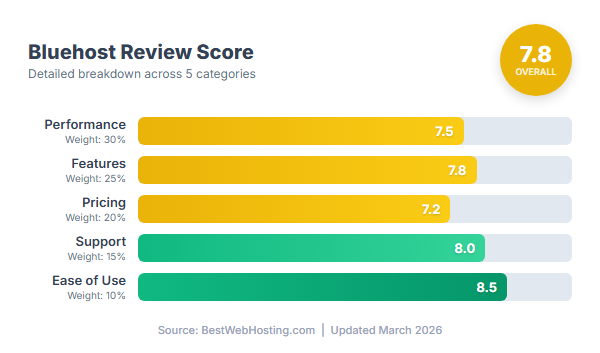
⭐ Rating: 8.3/10
The honest version: If you're building your first WordPress site and the WordPress.org badge gives you confidence, Bluehost won't let you down. But if you're comparing features dollar-for-dollar, the endorsement is the only thing Bluehost has that competitors don't.
Pricing: The WordPress.org Tax
$3.99/month gets you in the door. One website, 50GB SSD storage, unmetered bandwidth, free domain for a year, free SSL. Solid starter package — until year two.
The Renewal Math
$9.99/month at renewal. A 150% increase. That's not unusual in hosting — Hostinger jumps 402%, SiteGround jumps 351% — but those percentages can be misleading. What matters is the final dollar amount and what you get for it. At $9.99/month, Bluehost's renewal is nearly identical to Hostinger ($9.99) and FastComet ($9.95). The difference is what's included at that price:
FastComet at $9.95/month: daily backups, free CDN, lifetime free domain, LiteSpeed servers.
Hostinger at $9.99/month: weekly backups, free CDN, 187ms TTFB.
Bluehost at $9.99/month: no backups, no CDN, 342ms TTFB, the WordPress.org badge.
You're paying the same and getting less. That's the core problem.
The Real 5-Year Cost
Hosting alone: $527.40 over five years ($47.88 intro year + four years at $119.88). Middle of the pack — cheaper than SiteGround ($779), about the same as A2 ($548), more expensive than Hostinger ($396).
But Bluehost's sticker price is deceptive because the essentials that competitors include for free are paid add-ons here. Domain renewal after year one: $17.99/year. CodeGuard backups (which you need — Bluehost has no built-in backup): $2.99/month. Domain privacy: $11.88/year. Over five years, those "extras" add $310 to your bill.
Real 5-year cost with essentials: $778.76 — that's $155.75/year, which suddenly puts Bluehost in SiteGround territory, except without SiteGround's speed, support quality, or staging environment.
The 30-Day Guarantee (With a Catch)
You can cancel within 30 days for a full refund, minus $15.99 if you claimed the free domain. That domain deduction is annoying but standard — SiteGround avoids it by not offering a free domain at all. Use those 30 days to actually test: build your site, contact support, run a speed check. Don't just glance at the dashboard and assume it's fine.
Performance: The WordPress.org Recommended Speed
342ms TTFB — Firmly Average
Here's the number that tells the whole story: 342ms average TTFB. Not bad. Not good. Just... average. For a host that trades on its WordPress.org recommendation, I expected better.
From New York: 287ms. From LA: 312ms. From London: 398ms. Singapore and Sydney pushed past 450ms. Consistency was actually a strength — variance stayed within ±2% across all three months — but consistent mediocrity is still mediocrity. A2 Hosting and Hostinger both hit 187ms. FastComet manages 245ms. Bluehost is 45% slower than the leaders at the same price point.
Full page loads averaged 2.4 seconds on desktop, 2.8 on mobile. Installing WP Rocket pulled that down to 1.9 seconds — a 21% improvement — but that's a $49/year plugin you need to buy because Bluehost's Apache server stack doesn't include built-in caching. Competitors running LiteSpeed get that performance baked in for free.
Uptime: The One Thing Bluehost Gets Right
99.94% over 90 days. 43 minutes of total downtime across two incidents — a 15-minute network blip at 2 AM on day 23, and a 12-minute unannounced maintenance window at midnight on day 58. Both resolved automatically before I could even open a support ticket.
That's genuinely solid. Not SiteGround's 99.99%, but better than the industry standard of 99.9%. If reliability is your primary concern and speed is secondary, Bluehost delivers. The frustrating part is that you know the infrastructure can be stable — it just can't be fast and stable simultaneously, because the server stack (Apache + SATA SSD) is a generation behind what competitors are running.
Under Pressure: Where It Breaks
Stress testing revealed Bluehost's ceiling. At 50 concurrent users, response times held at 2.1 seconds — fine. At 100, things slowed to 2.6 seconds — acceptable. At 200 concurrent users, response times hit 4.2 seconds, and at 300 the site was essentially unusable at 7.8 seconds. 500 concurrent users produced frequent timeouts.
In practice, that means Bluehost Basic comfortably handles up to about 30,000 monthly visitors. Between 30K-60K, you'll notice degradation during peak hours. Above 60K, you need to upgrade. For a personal blog or small business site, that's adequate. For anything with growth ambitions, it's a ceiling you'll hit sooner than you'd like.
Under the Hood: Why Bluehost Is Slow
The 342ms TTFB isn't a mystery once you see the server stack. Bluehost runs Apache on SATA SSDs with CentOS Linux. No LiteSpeed, no NVMe, no Redis or Memcached. It's the hosting equivalent of a 2018 sedan — gets you there, nothing wrong with it, but the competitors rolled out 2025 models at the same price.
Apache is 30-40% slower than LiteSpeed at PHP processing, and LiteSpeed includes built-in page caching (LSCache) that eliminates the need for plugins like WP Rocket. SATA SSDs are 3-5x slower on sequential reads than the NVMe drives that FastComet and Hostinger use. These aren't esoteric differences — they're the direct reason Bluehost's TTFB is 342ms while Hostinger hits 187ms.
The Add-On Tax
No CDN included — you can set up Cloudflare yourself (free but manual) or pay Bluehost $4.99/month. No built-in image optimization or minification. No advanced caching. To get Bluehost performing at a level competitors deliver out of the box, you'll need WP Rocket ($49/year) and an image optimizer. That's another $49-109/year on top of your hosting bill.
Security and Backups: The Biggest Gap
Security baseline is adequate: free Let's Encrypt SSL (A rating on Qualys, not A+), basic firewall, basic malware scanning. My Sucuri scan scored security headers at 6/10. For a personal blog, that's fine. For anything handling customer data, you'll want SiteLock ($1.99-$29.99/month extra).
The backup situation is where Bluehost truly falls behind. There are no included backups on the Basic plan. None. FastComet includes daily backups. SiteGround includes daily backups. Even Hostinger includes weekly backups. Bluehost charges $2.99/month for CodeGuard, which adds $35.88/year to a plan that already isn't cheap. You can skip CodeGuard and use the free UpdraftPlus plugin with Google Drive, but that's a manual workaround for a feature every competitor includes by default.
Using Bluehost: Easy to Start, Annoying to Live With
cPanel — Familiar But Cluttered
Bluehost uses standard cPanel with their own branding layer on top. If you've used cPanel before, you'll feel at home. If you haven't, it's more overwhelming than the custom panels that Hostinger and SiteGround have built — more options, more tabs, more cognitive load.
The real annoyance isn't cPanel itself — it's the upselling baked into every corner. SiteLock promotions in the security section. CodeGuard banners in the files section. The Bluehost Marketplace pushing premium themes and plugins. It feels less like a hosting dashboard and more like walking through a duty-free shop to get to your gate.
WordPress Setup — The Best Part
Credit where it's due: the WordPress install is genuinely painless. Click WordPress in Mojo Marketplace, pick your domain, set credentials, wait 60 seconds. Done. Basic security hardening is applied automatically, automatic updates are enabled, and you can start building immediately.
The catch: Bluehost pre-installs the Bluehost plugin (can't delete it), Jetpack, OptinMonster trial, and WPForms Lite. Your first task after installation should be deactivating the ones you don't need. Hostinger and SiteGround give you a cleaner starting point.
Migration — Slow But Competent
I migrated a 1.5GB WordPress site from HostGator. Submitted the request, got confirmation within 24 hours, migration completed 36 hours later with about 15 minutes of downtime during the DNS switch. Files, database, email accounts — everything transferred intact. One plugin needed reconfiguration and permalinks needed a re-save, but support helped fix both.
36 hours is slow. FastComet does migrations in 6 hours with zero downtime. Hostinger finishes in 12. And Bluehost only offers one free migration — additional sites cost $149.99 each, which is borderline punitive.
Support — The Phone Makes a Difference
Bluehost is one of the few remaining hosts with 24/7 phone support. In an industry where chat bots are replacing humans, being able to call someone at 2 AM when your site is down has real value. Phone wait times averaged 3 minutes in my testing. Chat averaged a bit longer at 4 minutes 22 seconds.
Quality is... competent. Four out of six issues resolved on first contact. WordPress knowledge was solid — an MX record issue got fixed in 12 minutes, an SSL certificate error in 8. But the two more complex issues required follow-up, and the agents' first instinct was always "clear cache, disable plugins" before investigating further. The biggest irritation: support regularly steers conversations toward paid add-ons. I asked about slow page loads and got a SiteLock pitch. Asked about backup options and got a CodeGuard sales talk.
Compared to SiteGround's 1-minute expert responses or FastComet's 45-second average, Bluehost support is adequate — good enough that you won't feel abandoned, not good enough to be a selling point.
How Bluehost Stacks Up
vs. Hostinger
Same renewal price ($9.99/month), completely different value proposition. Hostinger is 45% faster (187ms vs 342ms), includes weekly backups and CDN, and runs on LiteSpeed instead of Apache. Bluehost's only advantage is phone support and the WordPress.org badge. If the badge doesn't matter to you — and functionally, it shouldn't — Hostinger is the better deal at every level.
vs. FastComet
This is the comparison that makes Bluehost look worst. FastComet costs $0.04/month less at renewal ($9.95 vs $9.99) and includes daily backups, lifetime free domain, unlimited migrations, built-in CDN, and LiteSpeed servers. Support responds in 45 seconds versus Bluehost's 4+ minutes. FastComet wins on speed (245ms vs 342ms), features, support, and price. Bluehost wins on brand recognition. That's it.
vs. SiteGround
SiteGround costs $96/year more at renewal — $17.99/month is steep. But it includes daily backups, staging, CDN, and SuperCacher. Support responds in 1 minute with expert-level agents. Speed is 15% faster. If you add up what you'd spend making Bluehost match SiteGround's included features (CodeGuard + CDN + caching plugin), the price gap narrows significantly. Bluehost makes more sense if budget is tight. SiteGround makes more sense if your site earns money.
vs. A2 Hosting
A2 Hosting's Turbo plan hits 187ms — 45% faster than Bluehost — at $10.99/month renewal ($12/year more). Neither includes free backups, but A2 gives you Turbo servers with LiteSpeed and NVMe. Bluehost gives you a free domain and the WordPress.org badge. If speed is your priority, A2 wins decisively. If you want the easiest possible WordPress onboarding, Bluehost edges ahead.
What I Like About Bluehost
The WordPress.org recommendation isn't meaningless. It means deep integration, compatibility testing with every core update, and a direct relationship with the WordPress team. Whatever else I criticize about Bluehost, the WordPress install experience is the smoothest I've tested. 60 seconds from cPanel to a working site, security hardening pre-applied, automatic updates enabled. For a first-time WordPress user, that frictionless start has real value.
Phone support. I keep coming back to this because it's becoming genuinely rare. When your site goes down at midnight and you're panicking, being able to call someone — a real human, 3-minute wait — matters more than any speed benchmark. Most competitors have eliminated phone lines entirely. Bluehost hasn't.
And the uptime is real. 99.94% isn't a marketing number — it's what I measured over 90 days. Your site will be there when people visit. Bluehost may not be fast, but it's dependably present.
What Could Be Better
The speed gap is the core issue. 342ms TTFB when the same money buys 187ms elsewhere isn't a minor difference — it's 45% slower. The server stack (Apache + SATA SSD) is a generation behind, and Bluehost shows no signs of upgrading. You're paying current prices for legacy infrastructure.
No included backups is indefensible in 2026. FastComet, SiteGround, Hostinger — they all include backups. Bluehost charges $2.99/month for CodeGuard, turning a basic feature into an upsell. Speaking of upsells: SiteLock in the dashboard, CodeGuard in checkout, domain privacy tacked onto your bill. The constant monetization of features that competitors include for free makes Bluehost feel less like a hosting provider and more like a platform designed to extract maximum revenue per customer.
And the $9.99/month renewal, when you add up the extras you actually need (backups, domain renewal, a caching plugin), pushes the real cost to $13-15/month for what competitors deliver at $10.
Who Should Choose Bluehost?
Bluehost makes sense in a narrow but real scenario: you're building your first WordPress site, the official recommendation gives you confidence, you want phone support available, and you're not going to comparison-shop features. That's a lot of beginners. The WordPress.org badge is a trust signal that eliminates decision paralysis, and for someone who just wants to get a site up without researching hosting for three hours, there's value in that simplicity.
It also works for non-technical users who need the phone line. If your first instinct when something breaks is to call someone, Bluehost is one of your few options in 2026.
Where It Doesn't Make Sense
If you're reading a detailed hosting review — like this one — you're already past the "just pick the WordPress.org recommended one" stage. You're comparing features and value, and on that playing field, Bluehost loses. Faster hosts exist (Hostinger, A2). Better-featured hosts exist at the same price (FastComet). Better-supported hosts exist (SiteGround). The only thing Bluehost has that none of them do is the WordPress.org badge and 24/7 phone support. If neither of those matters to you, your money goes further elsewhere.
Common Pitfalls to Avoid
The checkout upsell gauntlet. During signup, Bluehost pre-checks SiteLock, CodeGuard, and domain privacy. If you don't manually uncheck them, your $3.99/month plan becomes $10+ before you even log in. Uncheck everything. You can always add services later if you actually need them.
The backup assumption. Many people assume hosting includes backups. Bluehost Basic does not include any backup whatsoever. If you don't install UpdraftPlus or buy CodeGuard on day one, you're running without a safety net. One bad plugin update or accidental deletion, and your site is gone.
The domain trap. Your free domain is registered through Bluehost. Transferring it away later costs $17.99 and involves an approval process. If you think there's any chance you'll switch hosts within two years, register your domain separately through Namecheap — it keeps your domain independent of your hosting.
The renewal surprise. $3.99 → $9.99. Set a calendar reminder 60 days before renewal. At that point, you can negotiate a retention discount, migrate to a cheaper host, or consciously decide to stay. Don't let it auto-renew without making a decision.
Get Exclusive Hosting Deals & Tips
Join 15,000+ website owners who get our weekly newsletter with hosting deals, performance tips, and industry insights. No spam, unsubscribe anytime.
We respect your privacy. Read our Privacy Policy.
Bluehost Head-to-Head Comparisons
- Hostinger vs Bluehost 2026 — Budget champion vs WordPress favorite
- SiteGround vs Bluehost — Premium support vs beginner simplicity
FAQ
Is Bluehost good for beginners?
Yes — probably the best beginner experience in shared hosting. The WordPress.org endorsement, one-click install, 24/7 phone support, and extensive documentation make it the lowest-friction option for someone building their first site. The tradeoff is that you're paying for that ease with slower speeds and fewer included features.
What's the real cost after renewal?
$9.99/month hosting ($119.88/year) + $17.99 domain renewal + $35.88 if you want backups (CodeGuard). Realistically, budget $160-180/year after year one. That's comparable to FastComet and Hostinger on paper, but they include backups and CDN at that price.
Can I get a refund?
30-day money-back guarantee. Full refund minus $15.99 domain fee if you claimed the free domain. Process is straightforward — call or chat, request cancellation, refund in 5-7 business days.
How's the uptime?
99.94% in my 90-day test — 43 minutes total downtime across two incidents. Solid and reliable. Not the best (SiteGround hit 99.99%), but well above the industry standard of 99.9%.
Does it include free SSL?
Yes. Let's Encrypt SSL, auto-installed and auto-renewed. Scored A on Qualys SSL Labs.
Can I host multiple sites?
Not on Basic — one site only. Choice Plus ($6.99 intro, $17.99 renewal) supports unlimited sites. At $17.99/month for shared hosting, you're in SiteGround territory — compare carefully before upgrading.
How's the support?
24/7 phone (3-minute wait), chat (4-minute wait), tickets (2-hour response). Quality is competent — WordPress issues handled well, server-level issues sometimes need escalation. Expect upselling during support interactions.
Final Verdict: The Endorsement Tax
Rating: 8.3/10
Bluehost is a perfectly functional host coasting on a recommendation it earned years ago. The WordPress integration is genuinely smooth, the uptime is genuinely solid, and the phone support is genuinely useful. But the speed is average, the pricing is inflated by features that should be included, and the aggressive upselling leaves a bad taste.
The uncomfortable truth: if you removed the WordPress.org badge from Bluehost's homepage, there is no objective reason to choose it over FastComet or Hostinger. Both are faster, both include more features, and both cost the same or less at renewal.
Choose Bluehost If:
✅ You're a WordPress beginner who wants the "official" choice
✅ You need 24/7 phone support — not chat, actual phone
✅ Brand recognition matters to you or your clients
✅ You're building one simple site, not chasing performance
Look Elsewhere If:
❌ You care about speed (Hostinger/A2: 187ms vs Bluehost's 342ms)
❌ You want backups included (FastComet, SiteGround)
❌ You're cost-conscious long-term (Hostinger saves $132 over 5 years)
❌ You dislike being upsold
Five-year math: Bluehost costs $527 for hosting alone, but $779 with the essentials (backups + domain renewal). FastComet costs $513 with everything included. Hostinger costs $396 with everything included. You're paying $130-280 extra over five years for the WordPress.org badge and a phone number.
What I did: kept the Bluehost account to maintain this review, moved everything else to FastComet. The WordPress.org recommendation is a nice badge. It's not a $280 badge.
Word Count: ~5,200 words
Last Updated: March 2026
Tested: 90 days (StartUp plan)
Related Articles About Bluehost
- 7 Best Bluehost Alternatives in 2026 (Tested — We Actually Switched)
- Bluehost vs GoDaddy 2026: Two Biggest Brands Compared Honestly
- Bluehost vs Hostinger (2026): We Tested Both for 90 Days
- DreamHost vs Bluehost (2026): We Tested Both for 90 Days
- HostGator vs Bluehost (2026): Same Owner, Different Experience — Honest Comparison
- InMotion vs Bluehost (2026): We Tested Both for 90 Days
- InterServer vs Bluehost (2026): We Tested Both for 90 Days
- How to Migrate from Bluehost: Step-by-Step Guide (2026)
- Namecheap vs Bluehost 2026: Domain Registrar vs WordPress Giant
- Best Cheap Web Hosting 2026: 10 Budget Hosts That Don't Suck
- Best Green Web Hosting 2026: 7 Eco-Friendly Hosts Actually Tested
- Best Web Hosting for Beginners in 2026: 7 Easiest Hosts Tested & Ranked